


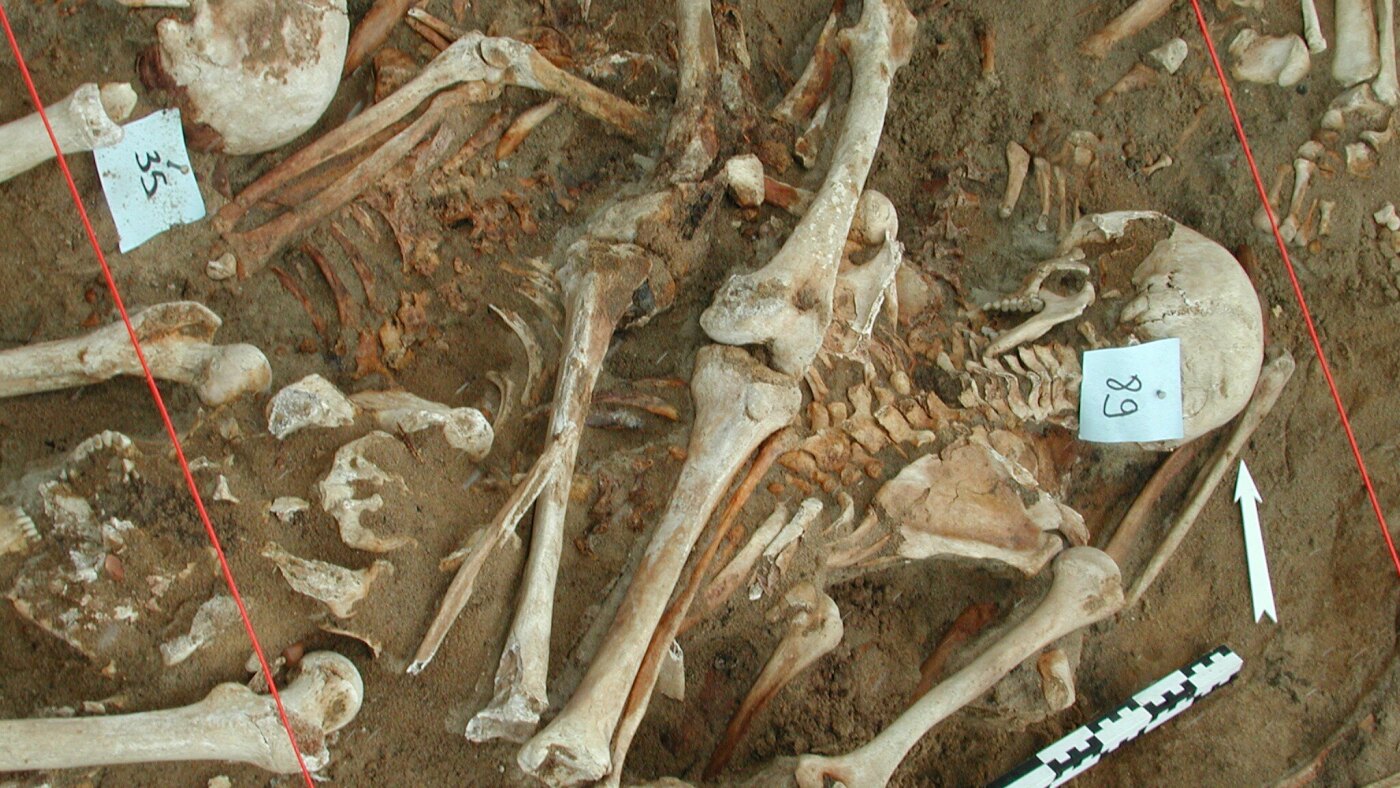
In 2001, 2-3,000 Napoleon’s soldiers were discovered in a mass grave on the northern outskirts of Vilnius, Lithuania.
Michel Signori / UMR 6578 University of Aix-Marseille, CNRS, EFS
hide caption
toggle caption
Michel Signori / UMR 6578 University of Aix-Marseille, CNRS, EFS
By 1812, Napoleon was in full power. Almost all of Europe was under his control. He succeeded in banning trade with Britain in large parts of the continent in order to bring the island nation to its knees. He married Marie Louise, the daughter of the then-powerful Emperor of Austria. (The dazzling emerald and diamond necklace he gave her on their wedding was one of the items stolen in last weekend’s incident.) Robbery at the Louvre. )
However, the Russian Empire resisted his efforts to cut off all trade with Britain. That summer, he ordered an army of about 600,000 to invade Russia. That would be a terrible decision.
“This is one of the most infamous military operations of the past few centuries,” he says. Nicholas Raskovanhead of the microbial paleogenomics unit at the Institut Pasteur in Paris. “He more or less believed he could conquer the whole world. Perhaps it was the beginning of the end.”

In October, Napoleon recalled his soldiers after almost engaging the Russian army. It wasn’t a loss, but it wasn’t a win either. Winter arrived early while they were marching home.
“They began to die from cold, hunger and even infections,” Raskovan said. In total, hundreds of thousands of people lost their lives.
And in a new study published in the journal current biologyRaskovan and his colleagues say these illnesses likely included two unexpected pathogens that could have helped hasten the soldiers’ deaths.
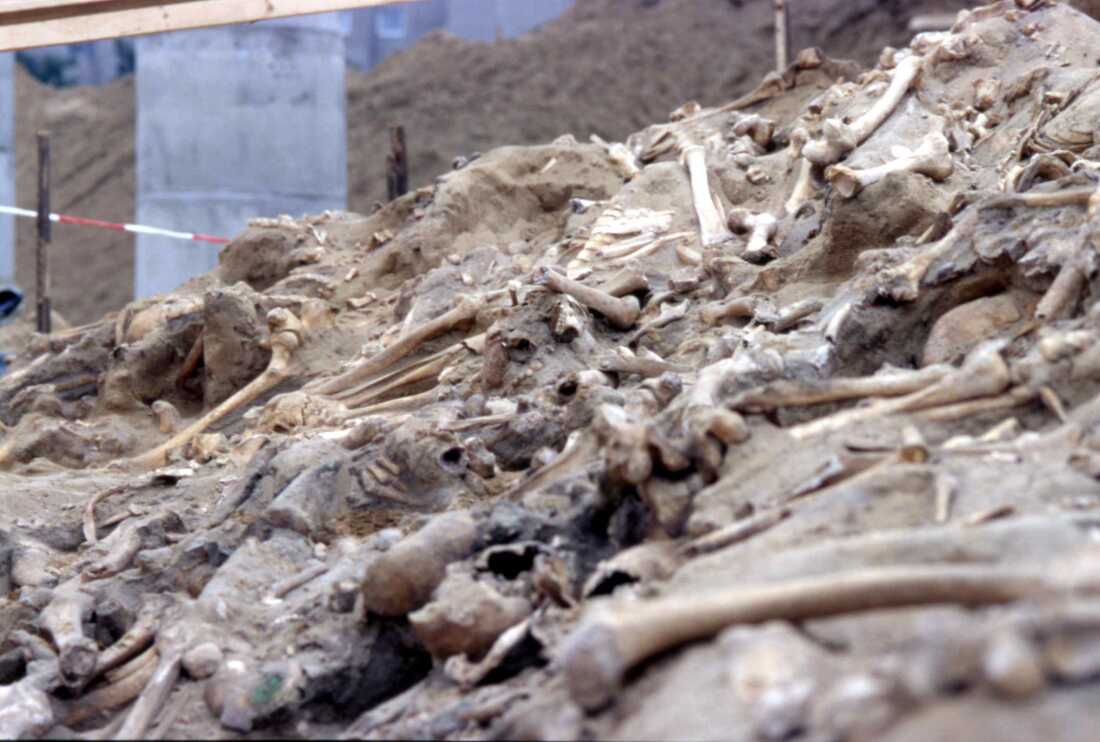
Napoleon’s retreating soldiers suffered from bitter cold, hunger, and an onslaught of disease.
Michel Signori / UMR 6578 University of Aix-Marseille, CNRS, EFS
hide caption
toggle caption
Michel Signori / UMR 6578 University of Aix-Marseille, CNRS, EFS
Combined with previous research, it became clear that these people were under microbial attack on all fronts.
“These wars were never glamorous,” he says. Michaela BinderHe is a bioarchaeologist at the Vienna-based archaeological firm Novetas, but was not involved in the study. “For some of them, death in battle may have been a relief.”

A rich and bloody history is reconstructed
Typhoid fever and trench fever have long been thought to be among the diseases that Napoleon’s soldiers suffered from. This is based on historical accounts, the discovery of body lice on the bodies of soldiers (they carried pathogens that transmitted disease), and DNA analysis It was carried out almost 10 years ago.
However, molecular technology has advanced dramatically since then.
So the two archaeologists asked Raskovan, who studies the DNA of ancient pathogens, what other diseases could be found in the remains of mass graves in Lithuania. The site was discovered by chance in 2001 during a construction project in the northern suburbs of Vilnius. Two to three thousand of Napoleon’s men were buried there immediately after their deaths.
“Europe has a rich history, so there are ruins almost everywhere,” Raskovan says. “So you dig a hole in the ground and you find something.”

Imperial Guard buttons were discovered during the excavation of a mass grave.
Michel Signori / UMR 6578 University of Aix-Marseille, CNRS, EFS
hide caption
toggle caption
Michel Signori / UMR 6578 University of Aix-Marseille, CNRS, EFS
Among the remains that archaeologists unearthed were 13 teeth, each belonging to a different soldier. It is thought that these teeth had blood flowing inside them long ago.
“If you have a pathogenic DNA in your blood because you have an infection, that DNA can get into your teeth,” Raskovan explains. “So this is like a time machine where you can actually see the blood of individuals from that time.”

Only after the teeth were decontaminated, ground into powder, and the bone powder dissolved could the ancient DNA be studied. But of course, that genetic code was in rough shape. It consisted of ultra-short fragments that underwent chemical changes.
Raskovan arranged them all. Some of the genetic material was obtained from the soldiers themselves. Some of it comes from organisms in the soil where they were buried. And some of that was – probably – due to the germs that helped kill these people.
“Once we have a huge list of all the different things that have been detected, we try to find which species match the human pathogen,” he says. “It’s like playing a puzzle.”

“Story of hardship”
After Rascovan and his team completed that puzzle, they had two hits. They were both bacteria, one causing paratyphoid fever and the other a body lice-borne pathogen dating back to the Iron Age that causes relapsing fever.
“This paper clearly shows how complex this type of analysis is and the extremely high level of skill required to work with this type of data.” leslie quaida paleopathologist at the Austrian Archaeological Institute, but did not participate in the study.
She says identifying the emergence, spread, and evolution of diseases in the past can also help address today’s pathogens.
“If we understand how a particular type of pathogen originates, we have a better chance of predicting its next steps,” Quaid says. Additionally, if certain pathogens that were once widespread are now rare, these infectious disease-filled historical events may provide lessons for learning how to prevent the pathogen’s recurrence and contain other similar modern-day pathogens.
These discoveries are another reminder that war is always ugly, Binder said. “The museum has paintings of soldiers in shiny armor and Napoleon on horseback, perfect for young people marching into battle.”
“But when you finally look at human remains, you see a completely different picture,” she says.
It depicts a lifetime of malnutrition, broken legs from marching too far and too fast, and a body riddled with disease.
“Their bones tell stories of suffering,” Binder said.
