


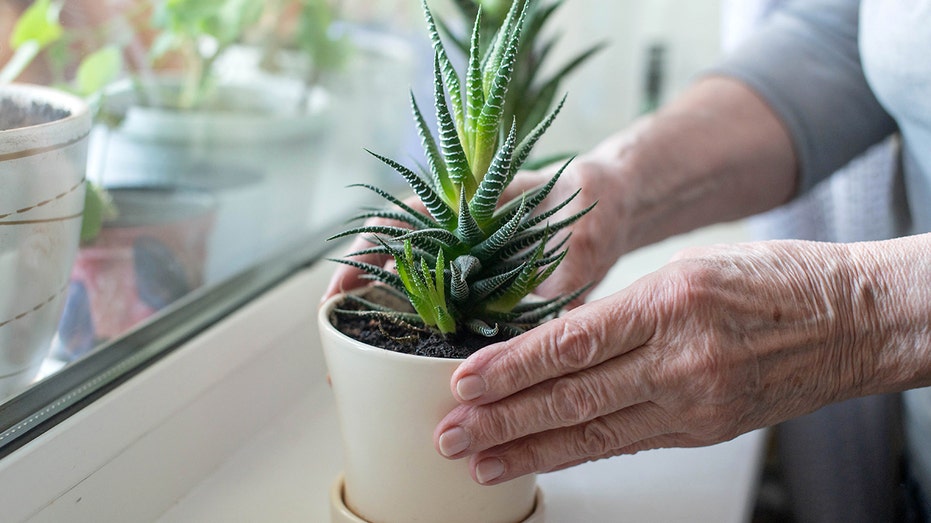
potential weapon against alzheimer’s disease Scientists recently discovered that there may be something hidden in aloe vera.
Aloe vera, a rubbery green plant, may be best known for its skin-soothing properties, but a study published in Current Pharmaceutical Analysis suggests that key chemicals in the plant may interact with enzymes involved in Alzheimer’s disease, suggesting a new approach to halting cognitive decline.
A chemical messenger in the brain called acetylcholine, which helps nerve cells communicate, is reduced in Alzheimer’s patients, contributing to memory loss and decline in cognitive function, according to a research press release.
Scientists reveal just one habit that can prevent age-related dementia
Two enzymes in the brain (cholinesterase and butyrylcholinesterase) play important roles in breaking down acetylcholine. drugs that slow down These enzymes may help preserve chemical messengers, improving patient symptoms.
Scientists used computer simulations to study this process and predict how the molecules would behave in the body.
“Our findings suggest that one of the Aloe Vera compounds, beta-sitosterol, exhibits remarkable binding affinity and stability, making it a promising candidate for further applications. drug discovery,” study lead author Meriem Kedraoui, a researcher at the University of Casablanca in Morocco, said in a press release.
Beta-sitosterol bound to key enzymes more strongly than any other compound tested in computer simulations. This suggests that the compound may be effective in slowing down these enzymes, the researchers noted.
Test yourself with our latest lifestyle quiz
“These results highlight the potential of beta-sitosterol as a dual inhibitor, which could be crucial in the management of Alzheimer’s disease,” added Professor Kedraoui.
The team then investigated the safety of such compounds to see if it was possible. used as medicine future. The compound was shown to be well absorbed in the body and unlikely to be toxic at therapeutic levels.
For more health stories, click here
“Comprehensive analysis supports the potential for these compounds to be safe and effective.” therapeutic drug” Sameer Chita, another author of the research paper from the University of Casablanca, said in the same press release.
The researchers acknowledged that the study was still in its early stages, given that the results relied solely on computer simulations rather than real-world examples.
Click here to sign up for our health newsletter
“This is because aloe vera supplements are commonly sold over the counter and no research has been conducted to verify aloe vera’s uses. person with alzheimer’s disease Dr. Christopher Weber, senior director of global science initiatives at the Alzheimer’s Association, told Fox News Digital.
Inhibiting cholinesterase in the brain does not slow or stop brain progression. brain cell death Weber, who was not involved in the study, pointed to other damage caused by Alzheimer’s disease.
Research suggests Alzheimer’s disease may be cured by restoring brain balance
“Therefore, even if these discoveries were later shown to be successful in human studies, this would not be a ‘disease-modifying’ treatment,” he added.
Further testing in laboratory experiments and clinical trials is required to confirm the effectiveness of such drugs.
“There are many treatments in various stages of development, from laboratory studies and animal models to human clinical trials, addressing this disease in multiple ways,” Professor Weber said.
He advised people who are concerned about their cognitive symptoms to talk to their doctor. More information is also available on the Alzheimer’s Association website. www.alz.org.
