


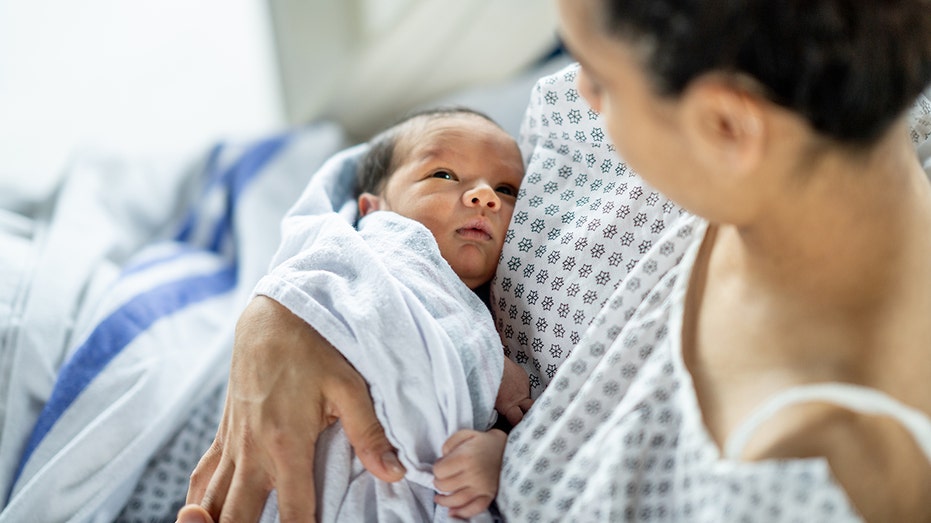
In the near future, starting a family may require robotic assistance.
Powered by AI In vitro fertilization (IVF) is the latest application of artificial intelligence, and laboratories and health centers around the world are adopting this new technology.
This includes the Columbia University Fertility Center in New York. The company’s Sperm Tracking and Recovery (STAR) methodology uses AI to identify viable sperm in men who: Fighting infertility.
Breast cancer hidden from targeted scans thanks to breakthrough technology
The Fertility Center has also developed a robot to assist the IVF laboratory and prepare specialized plates to maintain embryos.
A study published in the journal Fertility and Sterility found that the robot could prepare embryo culture plates 10 times more accurately than a human.
Dr. Zev Williams, director of the Columbia University Fertility Center, said in a statement to Fox News Digital that these technologies have been “truly transformative” for patients.
“Thanks to our innovation, babies are literally being born who could not have been conceived any other way,” he said. “We offer concrete solutions to couples who have struggled with infertility for years or even decades.”
Two other companies, Overture Life in California and Conceivable Life in New York, have developed AI-powered robotics to carry out the IVF process.
Conceivable Life CEO Alan Murray told Fox News Digital how his company’s AURA AI-powered IVF technology brings “robotic precision” to the delicate process.
“IVF requires extraordinary precision, but human hands, no matter how skilled, are subject to variation,” he says.
of AI technology “Everything will be automated,” Murray said, including sperm selection, egg preparation, sperm injection, embryo culture and egg freezing.
He said the technology is not intended to replace embryologists, but to support them with techniques that eliminate human error.
Murray said the technology is showing “early but promising data.” In a pilot study, we achieved a pregnancy rate of 51%, 19 healthy babies From trial participants.
AURA is targeting clinical launch in the U.S. in 2026, pending testing and validation.
Overture Life has developed a similar product system and is beginning to produce “live healthy babies,” CEO Hans Gangeskar said in an interview with Fox News Digital.
Test yourself with our latest lifestyle quiz
Overture’s flagship product, DaVitri, is a handheld device that automates egg freezing. The company also offers other technologies for embryo selection and fertilization.
Gangeskar said clinical trials have shown “very positive results” and the technology is expected to be launched in Europe “soon.”
Last week, the president donald trump One round of IVF in the US can cost up to $25,000, so the company announced plans to reduce IVF costs and expand access for American families.
It takes an average of three cycles for a baby to be born, but some women can take up to 15 cycles to give birth. viable pregnancyaccording to Dr. Stephanie Kuku, Chief Knowledge Officer at Conceivable Life.
Experts pointed out that creating an embryo in the lab requires 200 manual steps; robot assistant It could help embryologists make “complex decisions” more accurately and potentially reduce the number of cycles.
Murray said AI is “reimagining the laboratory” to increase efficiency, reduce the number of cycles and improve IVF success rates.
Click here to sign up for our health newsletter
“Right now, the outcome of IVF depends on which clinic you go to, which embryologist is working there, and whether you can afford multiple cycles,” he said. “Our vision is to change the technology doctors use so they can treat patients without major investments.”
The CEO said the technology could also take away some of the grief for families who have experienced multiple failed IVF cycles.
“Everyone has a limit to how much pain they can endure before they give up,” he says. “It’s incredibly personal.”
For those with specific religious beliefschoosing the IVF route can raise concerns.
“Different religious traditions have different views on assisted reproduction,” Murray said. “It’s very personal.”
He pointed out that “infertility does not discriminate,” as one in six people worldwide experience infertility problems.
“Our role is not to make those decisions for families, but to provide the technology to make them happen. family building It’s possible for those who choose this path,” Murray said.
Dr. Gangeskar acknowledged that religion “always comes up” when talking to patients about IVF options, noting that “Christian IVF” is emerging as an alternative option.
Historically, in Christian IVF, instead of collecting a large number of eggs, fertilizing them all, and then freezing the embryos, we freeze and fertilize them one by one, so there are no embryos left behind.
“This is where DaVitri is actually very helpful, because it lets you know that the eggs were frozen in the best way possible,” Gangeskar said.
Dr. Harvey Castro, a Texas ER doctor and AI expert who was not involved in the IVF study, told Fox News Digital that he considers it an “industrial revolution in reproductive medicine.”
But Castro warned that algorithmic errors can occur when making important decisions such as classifying embryos. This raises the question of who is responsible: clinicians, developers, AI vendors.
For more health stories, click here
He said most AI systems are validated based on limited patient data, so large, diverse, multicenter trials will be needed before these machines can be scaled up for clinical use.
“AI may help create life, but we have to respect that,” he says. “As physicians and AI futurists, we believe that our goal is not just to increase births, but to achieve a healthier start, responsibly, ethically, and equitably.”
