


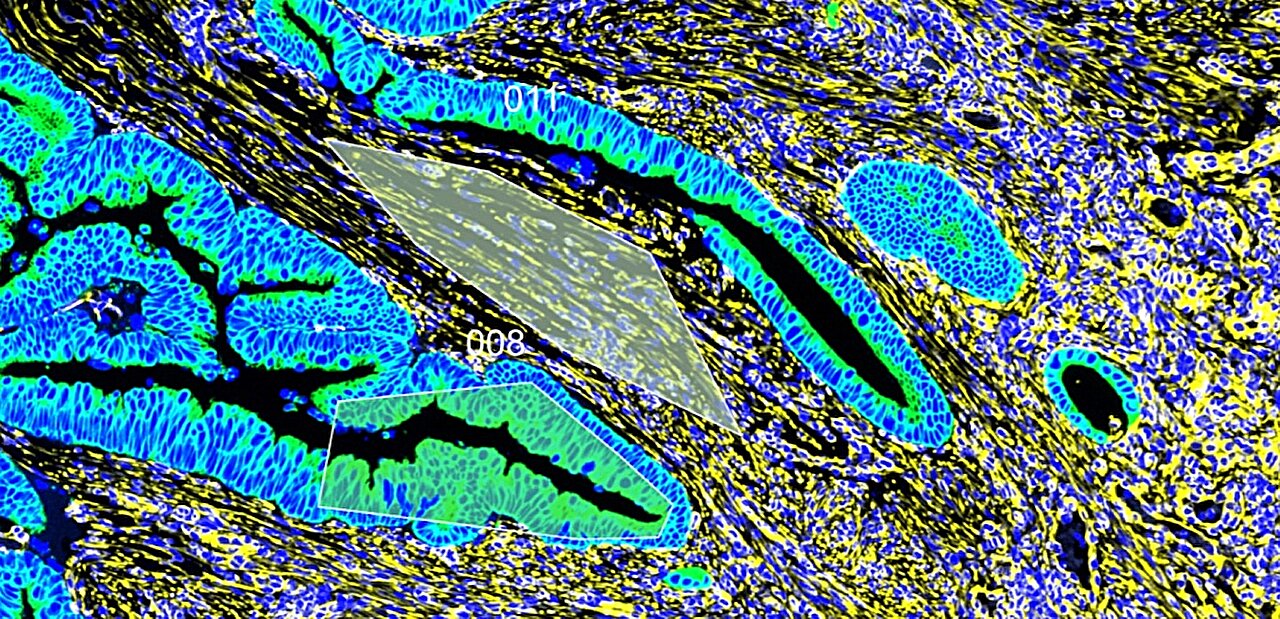
This image represents a spatial analysis of early-onset tumors. The polygon above “008” contains fibroblasts (stained yellow). There are cancer nests above and below the polygon. Note that the fibroblasts in this area are aligned and may form a “highway” for tumor cells to spread. Credit: UT Southwestern Medical Center
Increased colon stiffness caused by chronic inflammation may accelerate the development and progression of early-onset colorectal cancer (CRC), a study co-led by researchers at UT Southwestern Medical Center suggests. The survey results are cutting edge sciencecould lead to new ways to prevent and treat this deadly subset of colorectal cancer.
“We believe this study is an important advance toward identifying patients at risk for early-onset colorectal cancer and finding new ways to treat them,” said Emina Huang, MD, MBA, professor of surgery in the Division of Colorectal Surgery and executive vice chair for surgical research at UT Southwestern. She is also a professor of biomedical engineering at the Harold C. Simmons Comprehensive Cancer Center.
UT Southwestern partnered with researchers at the University of Texas at Dallas on this study.
“This is the first study to highlight the important role of biomechanical forces in the pathogenesis of early-onset colorectal cancer,” said Jacopo Ferruzzi, Ph.D., assistant professor of biomedical engineering at the University of Texas at Dallas and biomedical engineering at Southwestern University. “Our observations are consistent across multiple length scales and link connective tissue stiffening to changes in biochemical signaling in cancer cells.”
Changes in colorectal cancer incidence rate
CRC that is not caused by a genetic syndrome and occurs at an average age of 50 years or older is known as mean-onset or sporadic CRC. The average incidence and mortality rates of colorectal cancer have decreased over the past 30 years.
At the same time, the incidence and mortality of colorectal cancer that occurs before age 50, known as early-onset colorectal cancer, increased dramatically over the same period. Early onset colorectal cancer It currently accounts for approximately 12% of all colorectal cancers diagnosed in the United States since 2020.
The reason for this rapid increase is unknown. Most of the research in this area focuses on lifestyle, excess weight, and environmental exposures that can cause chronic intestinal inflammation and lead to colorectal cancer. However, it is unclear why chronic inflammation leads to early-onset colorectal cancer.
Research method and main results
Dr. Huang explained that chronic inflammation can cause scarring, which can gradually increase tissue stiffness over time. Such hardness is known to promote the development and progression of other types of cancer, such as breast and pancreatic cancer. She and her colleagues wondered whether a similar phenomenon might promote early-onset colorectal cancer.
To answer this question, researchers examined intestinal tissue from patients who underwent surgery to remove cancerous tumors at William P. Clements University Hospital and Parkland Health. 19 samples from patients with average-onset colorectal cancer and 14 samples from patients with early-onset colorectal cancer. Each sample contained not only the malignant tumor but also its non-cancerous margins.
The results showed that both tumor and non-cancerous tissue were significantly stiffer in samples from early-onset colorectal cancer patients compared to samples from average-onset colorectal cancer patients. These findings suggest that increased stiffness may occur before the onset of early colorectal cancer.
To explore the reason for this increased stiffness, the researchers examined collagen in both sample types. Collagen is a protein that increases in abundance and changes structure with scarring. They found that the collagen in early-onset samples was denser, longer, more mature, and more aligned than the collagen in average-onset samples. These factors highlight the role of scarring in early-onset CRC tissue.
When the scientists compared gene activity in the two types of samples, they found significantly increased expression of genes related to collagen metabolism, angiogenesis, and inflammation in early-onset CRC tissues, further supporting that scarring from chronic inflammation is responsible for tissue stiffness.
Implications for treatment and diagnosis
Importantly, they also molecular pathway Responsible for mechanical transduction, the process by which cells convert mechanical forces into biochemical signals. This suggests that cells within early-onset CRC samples may change their behavior based on the stiffness of the environment.
Not surprisingly, when the researchers grew CRC cell lines on substrates with varying levels of stiffness, they found that the cells grew faster and had increased stiffness on the stiffer substrates. Similarly, 3D organoid models made from CRC cells grew faster on stiffer substrates.
Together, Dr. Huang said, these findings suggest that a more stringent environment may cause colorectal cancer to develop and grow in people who develop early-onset colorectal cancer. They also support the idea that disrupting mechanotransduction molecular pathways in these cells can halt or reverse CRC initiation and proliferation, a strategy currently being considered for some other cancers. Developing a diagnostic test to assess intestinal stiffness could help identify people at risk for early-onset colorectal cancer, similar to how colonoscopies are used for average-onset colorectal cancer, Dr. Huang added.
Detailed information
Nicole C. Huning et al, Biomechanical phenotyping reveals unique mechanobiological features of early-onset colorectal cancer. cutting edge science (2025). DOI: 10.1002/advs.202514693
Magazine information:
cutting edge science
key medical concepts
Provided by
UT Southwestern Medical Center
quotation: Colon stiffness may indicate risk for early-onset colorectal cancer (December 23, 2025) Retrieved December 24, 2025 from https://medicalxpress.com/news/2025-12-stiffer-colon-early-onset-colorectal.html
This document is subject to copyright. No part may be reproduced without written permission, except in fair dealing for personal study or research purposes. Content is provided for informational purposes only.
